 Author: Murat BIYIKLI
Published: 2026-03-01
Author: Murat BIYIKLI
Published: 2026-03-01
The Silent Fabric of Space – Modern Cosmology: Book Overview
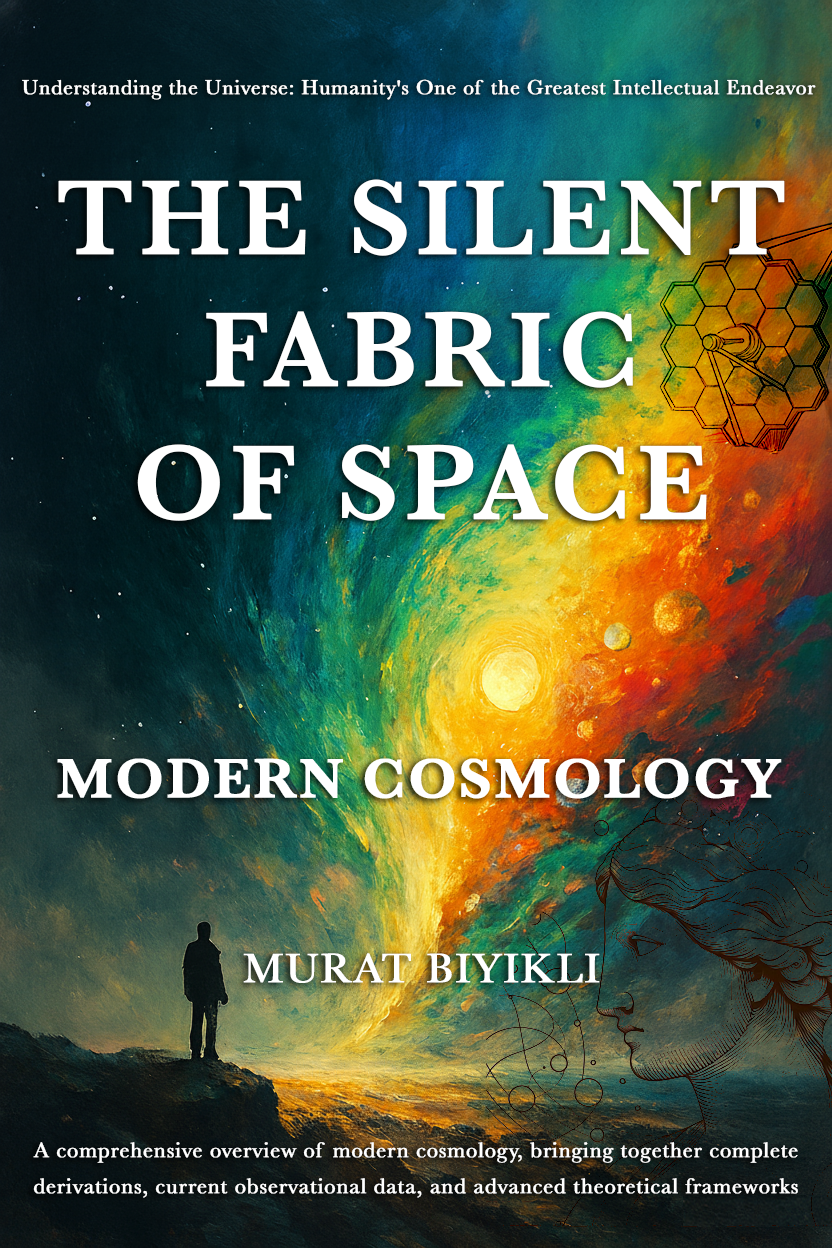 The Silent Fabric of Space – Modern Cosmology is a comprehensive cosmology book that traces the line from the universe’s beginning to today’s observational tensions, in an advanced yet fluid narrative. It keeps not only “what we know” but also why we know it in constant view.
What Does This Book Cover?
The book starts from the core geometric assumptions of cosmology and develops Friedmann dynamics, the ΛCDM model, inflation, and quantum cosmology as a single coherent structure. Measurements such as CMB, BAO, weak lensing, standard sirens, and large‑scale structure are read together with the theoretical framework.
Physical Meaning and Scientific Aim
Each chapter connects an observable (e.g., Hubble constant, power spectrum, B‑mode polarization) to its physical mechanism. The aim is to clarify the expansion history, matter‑energy content, and the origin of structure through a clear cause‑and‑effect chain.
Academic Level and Structure
The text targets a graduate‑level textbook standard. Derivations, observational constraints, statistical inference, and numerical tools (CAMB/CLASS, MCMC) are treated together, bringing theory and data onto the same axis.
What Is Being Investigated?
Cosmology measures the expansion rate, content components, quantum seeds of the early universe, and how galaxies grow. The book interprets each of these measurements physically and makes clear which questions remain open.
Who Is It For?
This book is a solid reference for readers who want academic depth, and a strong roadmap for research starts. It also provides a reliable narrative for curious readers who want a clear “big picture” of the universe.
Highlights
From inflation and primordial perturbations to dark matter candidates, from the Hubble tension and JWST early‑galaxy results to quantum cosmology, the book covers a wide spectrum and clearly shows the frontier of modern cosmology.
Short Conclusion
The Silent Fabric of Space – Modern Cosmology is a complete reference for anyone who wants to understand the physical architecture of the universe. By unifying theory and observation, it builds cosmology not as a story but as a computable science.
Read the Book: