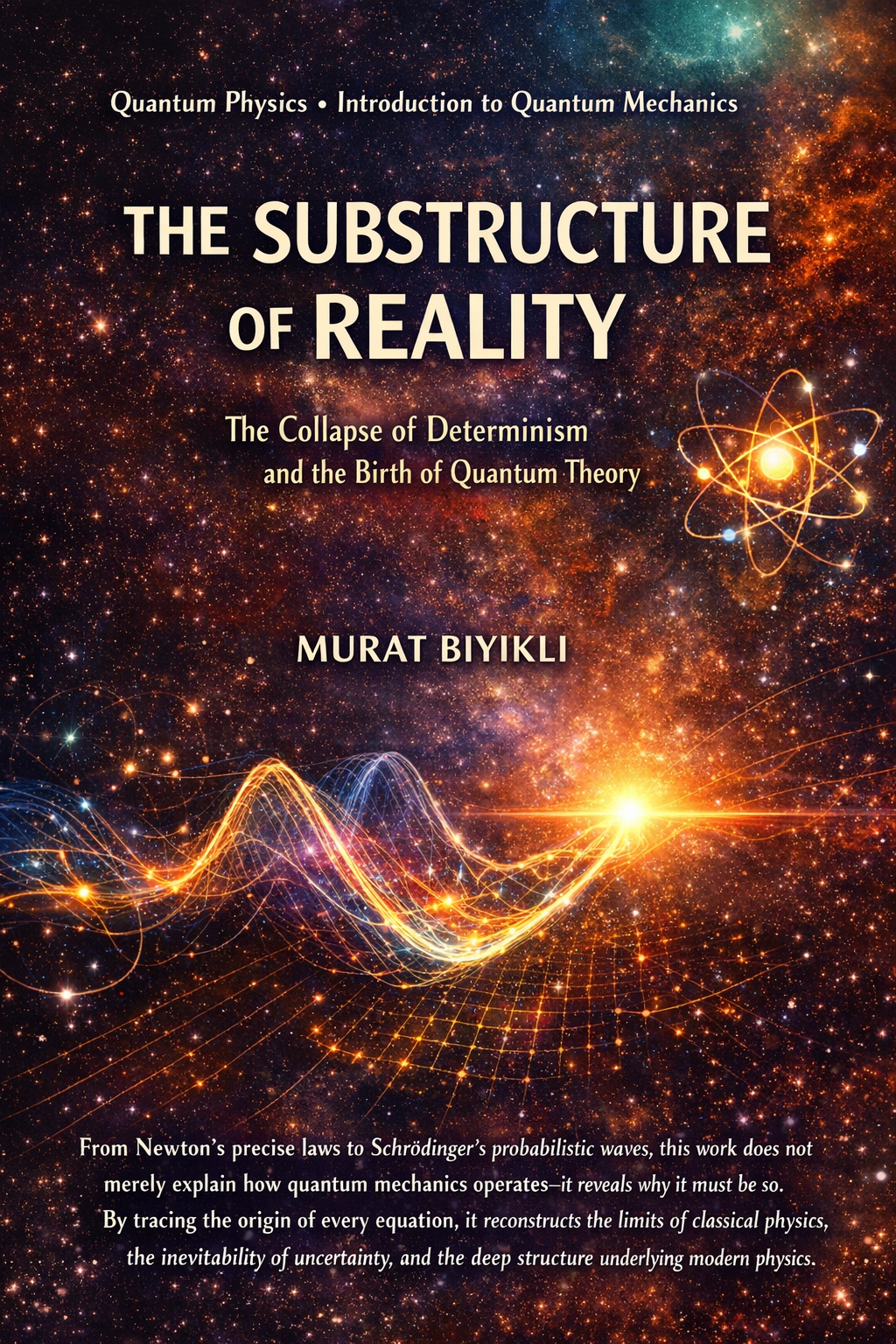
The Substructure of Reality - The Collapse of Determinism and the Birth of Quantum Theory
Copyright © 2026 Murat BIYIKLI · First Edition
All rights reserved. No part of this publication may be reproduced, distributed, or transmitted in any form or by any means without prior written permission of the author. The first edition of this book is provided free of charge in HTML format only.
Digital Signature & Verification
These methods are used to verify the originality and integrity of the work.
- You can confirm the file was published by the author and has not been altered.
- You can prove the file’s existence via a blockchain‑based timestamp.
- You can verify integrity with a local hash check.
CONTENTS
- Chapter 0 – Triumph and Collapse of Classical Physics
- Chapter 1 – Foundations of Classical Mechanics: Newton, Lagrange, Hamilton
- Chapter 2 – The Triumph of Electromagnetism and the Mystery of Light
- Chapter 3 – The Birth of Quantum Physics: Planck, Einstein, Bohr
- Chapter 4 – Wave Mechanics: The Schrödinger Equation
- Chapter 5 – Matrix Mechanics and Hilbert Space
- Chapter 6 – Core Principles of Quantum Mechanics
- Chapter 7 – The Hydrogen Atom and the Periodic Table
- Chapter 8 – Spin, Identical Particles, and the Pauli Principle
- Chapter 9 – Quantum Entanglement, Bell’s Theorem, and the Measurement Problem
- Chapter 10 – Approximation Methods: Perturbation and WKB
- Chapter 11 – 21st‑Century Quantum: QFT, Quantum Computing, and Speculative Frontiers
- Conclusion
- Appendices
Quantum mechanics is the most successful—and the most unsettling—physical theory in human history. It is successful because it predicts experiments to twelve decimal places; no other theoretical framework rivals this precision. It is unsettling because it describes the universe in a language that contradicts everyday intuition: particles can be in multiple places at once, observation helps define reality, and two particles can “feel” each other instantly across galaxies.
This book aims to present quantum mechanics on two levels. The first level is for curious readers who are not afraid of mathematics but have not received formal physics training. The second level is for university students and researchers—anyone who wants to see where the formulas come from, how they are derived, and what physical meaning they carry.
Our guiding principle is this: No formula falls from the sky. Every equation has a history, a physical motivation, and a logical root. Instead of presenting the Schrödinger equation as “quantum mechanics itself,” we will show why it was needed, which experiments forced it into existence, and where classical physics collapsed.
If we are to read the periodic table, we must first understand where electronic orbitals come from. If we speak of the Hamiltonian operator, we must see what William Rowan Hamilton built in 1833 for classical mechanics. If we speak of spin, we must first understand the shock of the Stern–Gerlach experiment.
The final chapters take you to the most exciting—and most disputed—territories of the 21st century: quantum computers, quantum field theory, multiverses, quantum gravity, and speculative frameworks about the quantum foundations of consciousness. We will clearly mark what is established science, what is active research, and what is speculative.
Because perhaps the greatest lesson of quantum mechanics is this: understanding reality is not about forcing it into our intuitions—it requires the courage to think in reality’s own language.
0.1 The Splendor of Classical Physics
By the late 1890s, physics was in its golden age. Newton’s mechanical framework (1687) explained planetary orbits, pendulum motion, and the fall of a projectile with stunning accuracy. Maxwell had unified electromagnetism into four equations (1865). Thermodynamics governed steam engines and chemical reactions. Wave optics explained interference and diffraction; acoustics understood sound waves.
In 1900, Lord Kelvin said: “I see only two small clouds on the horizon of physics.” Those two clouds were the ether problem (what carries light?) and blackbody radiation. Most thought the clouds would soon dissipate.
Lord Kelvin, 1900
“The beauty and clarity of dynamics are now obscured by two black clouds.”
Those two small clouds were in fact revolutions. The first led to Special Relativity. The second gave birth to Quantum Mechanics.
0.2 Three Major Crises
1. Blackbody Radiation: The Ultraviolet Catastrophe
A blackbody is an ideal object that absorbs all incident light. When heated, it emits radiation—ovens, stars, and incandescent filaments are real‑world approximations.
By the end of the 19th century, physicists measured the frequency distribution of blackbody radiation and tried to explain it. The Rayleigh–Jeans law, derived from classical thermodynamics and electromagnetism, predicted that energy density grows without bound at high frequencies (ultraviolet and beyond).
The formula matched experiments at low frequencies. But at high frequencies it diverged catastrophically—energy density went to infinity, contradicting measurements. Physicists called this the “Ultraviolet Catastrophe.”
Measurements showed a peak at a finite frequency and a decline beyond it. Classical physics could not explain this behavior.
2. Photoelectric Effect: Is Light a Particle?
When light strikes a metal surface, electrons are ejected, producing an electric current—this is the photoelectric effect. Classical wave theory predicted that higher intensity (brightness) would increase electron energy. Experiments showed the opposite:
- Increasing intensity increased the number of ejected electrons, not their energy.
- Increasing frequency increased electron energy.
- Below a threshold frequency, no electrons were ejected no matter how bright the light.
Classical wave theory had no explanation for these results.
3. Atomic Spectra: Why Lines?
An electric discharge through hydrogen gas emitted light at discrete colors: four visible lines (red, blue‑green, blue‑violet, violet). Why those specific frequencies? Why not a continuous rainbow? In 1885 Balmer found a formula that fit the lines—but no one could explain why.
The formula worked, but it did not answer “why.” The answer would come only with quantum mechanics.
⚠ Three Impossibilities of Classical Physics
Blackbody radiation predicted infinite energy emission → wrong. Light’s energy depended on frequency, not intensity → classical wave theory failed. Atoms emitted only discrete frequencies → classical electromagnetism could not explain it. All three crises pointed to the same fix: energy is not continuous but comes in packets.
1.1 Newtonian Mechanics: Force and Motion
In 1687 Isaac Newton, in the Principia Mathematica, formulated the three laws of motion. The second law is the foundation:
This is a differential equation: if you know the forces acting on a system, you find the position by solving a second‑order time derivative. Whatever the force—gravity, electromagnetic, elastic—you write the equation, solve it, and obtain the motion.
Newtonian mechanics explained planets, projectiles, pendulums, and waves for three centuries. But it had a major limitation: it was expressed only in terms of forces, and became cumbersome in complex geometries (curved surfaces, constraints).
1.2 Lagrangian Mechanics: Thinking in Energy
In 1788 Joseph‑Louis Lagrange (Mécanique Analytique) reformulated mechanics in terms of energy rather than forces. This was revolutionary because energy is a scalar—no direction required, coordinate‑independent.
The key quantity is the Lagrangian:
The equations of motion follow from the Euler–Lagrange equations. Their origin is the Principle of Least Action: nature minimizes the “action” between two points.
This formalism is remarkably powerful: choose any coordinates (Cartesian, polar, cylindrical, spherical), write the Lagrangian, and apply the equations. The need to compute every force vector individually disappears.
✓ Why It Matters
The Lagrangian formalism does more than simplify classical mechanics—it prepares the mathematical framework of wave mechanics, quantum field theory, and even General Relativity. The Principle of Least Action sits at the heart of Feynman’s path integral formulation in quantum mechanics.
1.3 Hamiltonian Mechanics: Phase Space and the Hamiltonian
In 1833 William Rowan Hamilton pushed Lagrange’s formalism further. The Lagrangian was written in terms of velocities ($\dot{q}$); Hamilton reformulated it in terms of momenta ($p$).
The generalized momentum is defined as:
Then the Hamiltonian is defined—a Legendre transform:
The equations of motion follow from the Hamiltonian via the elegant pair called Hamilton’s equations:
These equations invite us to think in phase space: the state of a particle is a point $(q,p)$, and motion is a trajectory in that space. This conceptual shift is crucial, because in quantum mechanics the Hamiltonian continues to govern the system—but now as an operator rather than a number.
💡 Why Is the Hamiltonian So Central?
In classical mechanics, $H$ represents total energy and fully determines the system. In quantum mechanics the same role persists: the operator $\hat{H}$ encodes the system’s time evolution and energy levels. That is why the term “Hamiltonian” is carried directly from classical physics into quantum physics.
1.4 Poisson Brackets: A Bridge to Quantum
Another elegant structure of Hamiltonian mechanics is the Poisson bracket. For two quantities $f$ and $g$:
Fundamental brackets: $\{q_i, p_j\} = \delta_{ij}$ (Kronecker delta—1 if $i=j$, otherwise 0).
In passing to quantum mechanics, these brackets become commutators:
This canonical quantization recipe gives the basic construction of quantum mechanics: classical quantities become operators, and Poisson brackets become commutators.
2.1 Maxwell’s Equations
In 1865, James Clerk Maxwell unified all known laws of electricity and magnetism—Gauss, Faraday, and Ampère—into the greatest synthesis of his era. The four Maxwell equations (SI units):
From these equations Maxwell showed that, in vacuum ($\rho=0$, $\vec{J}=0$), the electric and magnetic fields satisfy a wave equation:
This speed matched the measured speed of light. Maxwell proclaimed: light is an electromagnetic wave. It was the great unification of the 19th century—electricity, magnetism, and optics in one theory.
2.2 The Great Question About the Nature of Light
Maxwell’s equations were perfect—but left one question: in what medium does the wave oscillate? Sound waves travel in air, water waves in water. What carries light? The proposed answer was the “ether,” an invisible medium filling space.
In 1887 Michelson and Morley compared light propagation with and against the ether. Result: no difference. There was no ether. Light traveled through empty space with the same speed in every direction. This led to Special Relativity (Einstein, 1905). Yet a deeper question remained: if light is a wave, its energy should be continuous. Blackbody and photoelectric experiments said otherwise.
2.3 The Atom Problem of Classical Electromagnetism
According to classical electromagnetism, an electron orbiting a nucleus is accelerating and should continually radiate, losing energy. Calculations were clear: the electron should spiral into the nucleus and the hydrogen atom should collapse in about $10^{-11}$ seconds.
But atoms do not collapse. Hydrogen has been stable for billions of years. Classical electromagnetism was fundamentally incompatible with atoms—new physics was required.
3.1 Planck’s Desperate Step (1900)
Max Planck struggled to solve blackbody radiation. He wanted a formula that matched experiments, yet classical thermodynamics kept producing the ultraviolet catastrophe.
Planck made a desperate assumption: electromagnetic oscillators (atoms) could exchange energy not continuously but only in discrete packets. Each packet had size:
The law derived under this assumption matched experiments perfectly:
At low frequencies ($h\nu \ll k_BT$) the formula reduces to Rayleigh–Jeans. At high frequencies the exponential suppresses energy, preventing the ultraviolet catastrophe.
⚠ Planck’s Own Doubt
Planck called his step a “mathematical trick.” He did not believe energy was truly discrete; he only wanted a working formula. The first to accept the reality of energy quanta was Einstein in 1905.
3.2 Einstein’s Photoelectric Solution (1905)
In 1905 Albert Einstein took Planck’s energy packets seriously and went further: light itself consists of packets (photons), not a continuous wave spread through space.
Photon
The energy packet of electromagnetic radiation. A massless particle carrying energy $E=h\nu$ and momentum $p=h/\lambda=\hbar\omega/c$.
With this assumption, the entire photoelectric effect was explained. A minimum energy is required to liberate an electron from a metal—this is the work function $\phi$. If photon energy $h\nu$ exceeds this threshold, the electron is emitted and the excess becomes kinetic energy:
This formula predicts: (1) below the threshold frequency $\nu_0=\phi/h$, no electrons are emitted no matter how bright the light is; (2) kinetic energy increases linearly with frequency; (3) intensity affects only the number of emitted electrons. Millikan confirmed all predictions in 1916. Einstein received the 1921 Nobel Prize for this discovery.
3.3 Compton Scattering (1923): Photon Momentum
Arthur Compton observed that when X‑rays scatter off electrons, the scattered wavelength increases—as if the photon had been “kicked” and lost energy. It was a direct particle‑particle collision.
This result proved that photons carry not only energy but also momentum. Wave‑particle duality was now a concrete fact.
3.4 De Broglie: Is Matter a Wave Too? (1924)
If light is both wave and particle—Louis de Broglie asked—could electrons also be both? This bold proposal was submitted as a PhD thesis (advisers were skeptical and asked Einstein; he called it “excellent”).
This relation already followed for photons from Einstein–Planck ($E=pc$ and $E=h\nu=hc/\lambda \Rightarrow p=h/\lambda$). De Broglie generalized it to all matter particles.
In 1927 Davisson and Germer scattered electron beams off crystal surfaces and observed interference patterns—just like X‑rays. De Broglie was right: electrons have wavelengths. He won the Nobel Prize in 1929.
3.5 The Bohr Model (1913): A Semi‑Quantum Atom
In 1913 Niels Bohr built a semi‑classical model of the hydrogen atom. His logic: electrons can move only in certain circular orbits and, in those orbits, do not radiate despite classical predictions.
Bohr’s quantization condition:
Why should this be true? In hindsight via de Broglie: with $\lambda=h/p=h/m_ev$, the orbit circumference must be an integer multiple of the wavelength: $2\pi r = n\lambda \Rightarrow m_ev r = n\hbar$. Bohr was saying the electron wave must form a standing wave around the orbit.
With this condition, orbital radii and energy levels are obtained. The Bohr radius:
Emission frequency between two levels:
Balmer’s empirical 1885 formula was now derived theoretically—Bohr’s great triumph.
⚠ Limits of the Bohr Model
The Bohr model worked for hydrogen but failed even for helium. It could not explain spin, could not predict line intensities, and did not describe full 3‑D orbits. It was semi‑classical: quantum numbers existed but waves did not. The full theory arrived in 1925–1926.
4.1 The Wave Function Idea
De Broglie had predicted that matter has wave properties. But what exactly was that wave? What equations did it obey? In 1926 Erwin Schrödinger answered this.
The core idea: the state of a particle can be described by a wave function $\Psi(\vec{r}, t)$ spread through space. This function takes complex values and contains the full information about the particle.
Wave Function $\Psi$
A complex‑valued function that contains the complete information of a quantum system. It is not measured directly, but $|\Psi(\vec{r},t)|^2$ gives the probability density of finding the particle at $\vec{r}$ (Born rule, 1926).
4.2 Deriving the Schrödinger Equation
The Schrödinger equation cannot be derived in the strict sense—it is a postulate, like Newton’s second law. But we can motivate it as follows.
For a free particle, the de Broglie wave is:
Using the classical energy–momentum relation $E = p^2/2m + V$ (the Hamilton function):
Notice: $\hat{H}$ has the same structure as Hamilton’s classical Hamiltonian from 1833—but now it is an operator, not a number. The kinetic term $p^2/2m$ becomes the operator $-\hbar^2\nabla^2/2m$.
4.3 Time‑Independent Schrödinger Equation
If the potential $V$ is time‑independent, variables separate. Writing $\Psi(\vec{r},t)=\psi(\vec{r})\,\phi(t)$:
This is an eigenvalue equation. The operator $\hat{H}$ has eigenvectors $\psi_n$ (energy eigenstates) and eigenvalues $E_n$ (energy levels). Time evolution:
4.4 Infinite Potential Well: The First Solution
The simplest system: a particle confined in one dimension, $0\le x\le L$ (infinite walls outside). Inside, $V=0$; outside, $\psi=0$.
The Schrödinger equation inside:
$$-\frac{\hbar^2}{2m}\frac{d^2\psi}{dx^2} = E\psi$$
Solution: $\psi(x)=A\sin(kx)+B\cos(kx)$, with $k=\sqrt{2mE}/\hbar$.
Applying boundary conditions $\psi(0)=0$ and $\psi(L)=0$:
Results:
- Energy quantization emerges automatically—no extra postulate required, boundary conditions suffice.
- The lowest energy $E_1 \neq 0$—the particle is never completely at rest (zero‑point energy).
- As $n$ increases, the number of nodes increases—oscillation becomes more “classical.”
4.6 Finite Potential Well: Bound and Scattering States
Real wells are not infinitely deep. Consider a finite well: $V(x)=-V_0$ inside, $V(x)=0$ outside. Two types of solutions appear: bound states ($E<0$) and scattering states ($E>0$). For bound states the wavefunction decays exponentially outside; for scattering states oscillations persist.
Boundary conditions enforce continuity of $\psi$ and $\psi'$, yielding transcendental equations for energy levels. For even solutions, for example:
4.7 Potential Barrier and Tunneling
Even if particle energy is below the barrier height ($Etunneling underlies alpha decay, semiconductors, STM, and nuclear fusion.
4.8 Harmonic Oscillator: Spectrum and Ladder Operators
The harmonic oscillator is the “test bed” of quantum mechanics: molecular vibrations, field quantization, and solid‑state phonons all reduce to it. The potential is:
The ladder (creation/annihilation) operators make the solution especially transparent:
4.5 Born Rule: The Meaning of the Wave Function
What does the wave function mean physically? Schrödinger initially thought it was a “charge density.” Max Born (1926) gave the correct interpretation:
Born Rule
$|\Psi(\vec{r}, t)|^2 \, d^3r$ gives the probability of finding the particle within the volume $d^3r$ around $\vec{r}$ at time $t$. The integral over all space equals 1:
$$\int_{-\infty}^{+\infty} |\Psi|^2 \, d^3r = 1 \quad \text{(normalization)}$$
This interpretation is profound: before measurement, the particle’s position is indefinite, and the wave function gives the distribution of possible positions. Upon measurement a specific position is found and the wave function “collapses” to that point. This collapse remains one of the most debated issues in quantum mechanics.
5.1 Heisenberg’s Matrices (1925)
In the summer of 1925, while recovering from hay fever on the island of Heligoland, Werner Heisenberg developed the first complete formulation of quantum mechanics—before Schrödinger’s waves—using matrices.
Heisenberg’s idea: abandon unobservable quantities (like electron orbits) and focus only on measurable quantities (emitted light frequencies and intensities). Position $x$ and momentum $p$ were no longer numbers, but matrices.
Born and Jordan systematized Heisenberg’s results. The key relation:
This is the quantum counterpart of the Poisson bracket $\{x,p\}=1$ from Chapter 1: $\{x,p\} \to [\hat{x},\hat{p}]/i\hbar = 1$.
Operators are represented by matrices: $\hat{x}$ and $\hat{p}$ have infinite‑dimensional matrix representations and their product depends on order—$\hat{x}\hat{p} \neq \hat{p}\hat{x}$. This is a fundamental difference between quantum and classical mechanics.
5.2 Hilbert Space: The Arena of Quantum Theory
Although Schrödinger waves and Heisenberg matrices looked different, in 1926 Schrödinger and independently Dirac showed they are representations of the same theory. The abstract framework is called Hilbert space.
Hilbert Space
An infinite‑dimensional vector space with an inner product, complete in the sense that Cauchy sequences converge. In quantum mechanics, states are vectors in this space.
5.3 Dirac Notation (Bra–Ket)
Paul Dirac developed an elegant notation that unifies both formalisms. It remains the most widely used language in physics.
In Schrödinger’s picture, the position representation is $\psi(x)=\langle x|\psi\rangle$. In the matrix representation, $|\psi\rangle$ is a column vector and $\hat{A}$ is a matrix.
5.4 Observables and Hermitian Operators
The operators corresponding to physical observables must be Hermitian (self‑adjoint): $\hat{A}^\dagger=\hat{A}$. Two important consequences follow:
- Hermitian operators have real eigenvalues—measurement results are real.
- Eigenstates with distinct eigenvalues are orthogonal: $\langle\psi_m|\psi_n\rangle = \delta_{mn}$.
The expectation value of $\hat{A}$ in state $|\psi\rangle$:
6.1 Heisenberg Uncertainty Principle
In 1927 Heisenberg announced quantum mechanics’ most famous—and most misunderstood—result: position and momentum cannot be known simultaneously with arbitrary precision.
Derivation: for two Hermitian operators $\hat{A}$ and $\hat{B}$, the general uncertainty relation (Robertson, 1929):
Setting $\hat{A}=\hat{x}$, $\hat{B}=\hat{p}$ and $[\hat{x},\hat{p}]=i\hbar$:
$$\Delta x \cdot \Delta p \geq \frac{1}{2}|i\hbar| = \frac{\hbar}{2} \checkmark$$
⚠ A Common Misunderstanding
The uncertainty principle does not say “the measuring device disturbs the particle.” It expresses a basic fact: a wave packet localized in position must contain a wide range of frequencies (and thus momenta). This follows from Fourier analysis—the unavoidable mathematical property of any wave.
The energy–time uncertainty follows similarly:
6.2 The Superposition Principle
The Schrödinger equation is linear. If $|\psi_1\rangle$ and $|\psi_2\rangle$ are valid solutions, then $\alpha|\psi_1\rangle + \beta|\psi_2\rangle$ is also a valid solution. This is the superposition principle.
Superposition
A quantum system can be a linear combination of multiple non‑exclusive states. Until measurement, the system exists in this “overlap” of states.
Example: an electron can be in a superposition of spin‑up ($|\uparrow\rangle$) and spin‑down ($|\downarrow\rangle$):
$$|\psi\rangle = \alpha|\uparrow\rangle + \beta|\downarrow\rangle, \quad |\alpha|^2 + |\beta|^2 = 1$$
When spin is measured, only $|\uparrow\rangle$ or $|\downarrow\rangle$ is found—with probabilities $|\alpha|^2$ or $|\beta|^2$.
6.3 Measurement and Wave‑Function Collapse
Perhaps the most unsettling feature of quantum mechanics: before measurement the system is a superposition of multiple outcomes; after measurement it “collapses” to a specific eigenstate. This collapse is sudden, probabilistic, and irreversible.
Mathematically: $|\psi\rangle=\sum_n c_n|\phi_n\rangle$ (expansion in eigenstates). Measuring $\hat{A}$ yields $a_n$ with probability $|c_n|^2$ and collapses the system to $|\phi_n\rangle$.
What physical mechanism causes this “collapse”? Quantum mechanics does not answer this—or different interpretations propose different answers (see Chapter 9).
6.4 Postulates of Quantum Mechanics
💡 Summary of the Core Postulates
- State: The system is fully represented by a vector $|\psi\rangle$ in a Hilbert space.
- Observables: Each physical quantity corresponds to a Hermitian operator.
- Measurement outcomes: Only operator eigenvalues can be measured. The probability of $a_n$ is $|\langle\phi_n|\psi\rangle|^2$.
- Collapse: After measuring $a_n$, the system transitions to $|\phi_n\rangle$.
- Time evolution: The system evolves via $i\hbar\,\partial|\psi\rangle/\partial t = \hat{H}|\psi\rangle$.
7.1 From Spherical Symmetry to Separation of Variables
Hydrogen: a single electron around a proton. If the proton is treated as fixed ($M_p \gg m_e$), the potential depends only on $r$—the Coulomb potential:
In spherical coordinates the Schrödinger equation is written as $\psi(r,\theta,\phi)=R(r)\,Y(\theta,\phi)$. Variables separate, yielding two equations.
7.2 Angular Momentum: Where Do $\ell$ and $m$ Come From?
The angular part is an eigenvalue problem for the angular‑momentum operator:
$Y_\ell^m(\theta,\phi)$ are the spherical harmonics. When you write $\hat{L}^2$ in spherical coordinates, you obtain a Legendre differential equation in $\theta$. Regular solutions that behave well on $\theta\in[0,\pi]$ exist only for integers $\ell=0,1,2,\ldots$. Boundary conditions again generate the quantum numbers.
Where do these constraints come from? Purely from boundary conditions: the wavefunction must be single‑valued under $\phi\to\phi+2\pi$, regular at $\theta=0,\pi$, and vanish as $r\to\infty$. These conditions fix the quantum numbers and therefore the energy levels.
7.3 Radial Equation and Energy Levels
With $u(r)=rR(r)$, the radial part becomes an effective one‑dimensional Schrödinger equation:
The second term is the centrifugal barrier—angular momentum’s effect on radial motion. The bound‑state condition $u\to 0$ as $r\to\infty$ is satisfied only for specific $E$ values:
The same result as the Bohr model—but now obtained purely from the Schrödinger equation, without any semi‑classical assumptions.
7.4 Orbitals and the Periodic Table
Each combination of $(n,\ell,m)$ defines an orbital. Orbitals are named in spectroscopic notation:
| $\ell$ | Notation | $m$ values | Number of orbitals |
|---|
| 0 | s | 0 | 1 |
| 1 | p | -1, 0, +1 | 3 |
| 2 | d | -2,...,+2 | 5 |
| 3 | f | -3,...,+3 | 7 |
Why Is the Periodic Table Shaped This Way? — From $\theta$ to Mendeleev
A student can trace the logic as follows: (1) the Schrödinger equation gives the $(n,\ell,m)$ quantum numbers for hydrogen. (2) Spin (Chapter 8) allows two electrons per orbital. (3) The Pauli exclusion principle forbids identical quantum numbers. (4) Electrons fill orbitals in order of increasing energy.
$n=1$: $\ell=0$ → 1s orbital → 2 electrons → H, He (period 1)
$n=2$: $\ell=0$ (2s, 2 e⁻) + $\ell=1$ (2p, 6 e⁻) → 8 electrons → Li to Ne (period 2)
$n=3$: $\ell=0$ (3s) + $\ell=1$ (3p) → 8 electrons (3d fills later) → period 3
The 2, 8, 8, 18, 18… structure of the periodic table follows directly from allowed quantum‑number combinations. Mendeleev’s 1869 empirical order emerged from the Schrödinger equation in 1926.
8.1 The Stern–Gerlach Experiment (1922)
Otto Stern and Walther Gerlach sent silver atoms through a non‑uniform magnetic field. Classical mechanics predicts a continuous spread of deflections. Result: only two spots. The atom deflected in only two directions.
Where did the two values come from? For orbital angular momentum $\ell$, one expects $2\ell+1$ values; for silver $\ell=0$, i.e., a single value. Yet two appeared. Uhlenbeck and Goudsmit (1925) proposed an intrinsic angular momentum—spin—with $s=1/2$.
For spin‑1/2 there are two states: $|{\uparrow}\rangle = |+1/2\rangle$ (“spin‑up”) and $|{\downarrow}\rangle = |-1/2\rangle$ (“spin‑down”). Spin operators are represented by the $2\times 2$ Pauli matrices:
8.2 Spin as a Necessary Consequence of Relativity
Spin does not emerge from the Schrödinger equation—it must be added as a postulate. But when Paul Dirac wrote the relativistic quantum equation in 1928, spin appeared naturally. Thus spin is a necessary consequence of combining quantum mechanics with special relativity.
8.3 Identical Particles
In classical physics two balls are distinguishable—we can track which is which. In quantum mechanics, identical particles are fundamentally indistinguishable. How does the wavefunction behave when two electrons are exchanged?
Particle Statistics
Bosons (integer spin: 0, 1, 2, ...): the wavefunction is symmetric under exchange, $|\psi(1,2)\rangle = +|\psi(2,1)\rangle$. An unlimited number can occupy the same state. Examples: photon, $\alpha$ particle, $^4$He.
Fermions (half‑integer spin: 1/2, 3/2, ...): the wavefunction is antisymmetric, $|\psi(1,2)\rangle = -|\psi(2,1)\rangle$. The Pauli exclusion principle follows.
8.4 The Pauli Exclusion Principle
If two fermions had identical quantum numbers, antisymmetry would require:
$$|\psi(1,2)\rangle = -|\psi(2,1)\rangle = -|\psi(1,2)\rangle \implies |\psi\rangle = 0$$
A zero wavefunction is physically meaningless. Therefore two fermions cannot share the same quantum numbers. This is the Pauli exclusion principle, foundational from chemistry to materials science:
- Electrons in the same orbital must have opposite spins → chemical bonds.
- Shell filling determines chemical properties → the periodic table.
- Electron degeneracy pressure can halt stellar collapse → white dwarfs.
- Band structure and conductivity in solids derive from Pauli exclusion.
9.1 The EPR Paradox (1935)
Einstein, Podolsky, and Rosen (EPR) published a famous thought experiment in 1935 arguing that quantum mechanics is “incomplete.” Let two particles interact and then separate. The particles are entangled:
If A is measured as $|\uparrow\rangle$, B is instantly $|\downarrow\rangle$—even if millions of light‑years away. Einstein called this “spooky action at a distance” and rejected it. He proposed “hidden variables”: perhaps the spins were predetermined and we just didn’t know.
9.2 Bell’s Theorem (1964)
In 1964 John Bell proved a remarkable result: any local realistic theory with hidden variables cannot reproduce quantum correlations for certain measurements. This is expressed as Bell inequalities.
Simplest form (CHSH inequality):
Do experiments violate the inequality or preserve it? Aspect et al. (1982), Zeilinger et al. (1998, 2015), and Hensen et al. (2015—“loophole‑free”): the inequality is violated, confirming quantum mechanics.
Conclusion: the universe is not local or not realistic (or both). Entanglement is real.
💡 Entanglement Does Not Transmit Information
Entanglement does not enable faster‑than‑light communication: A’s outcome is random, and so is B’s. Correlation appears only when results are compared—via a classical channel limited by light speed.
9.3 Interpretations of Quantum Mechanics
There is consensus on the mathematical formalism—its equations are undisputed. But what those equations mean has been debated for over a century.
| Interpretation | Wave function | Collapse | Advocates |
|---|
| Copenhagen | Computational tool | Real upon measurement | Bohr, Heisenberg |
| Many Worlds | Real, universal | None (branching) | Everett, Deutsch |
| Pilot Wave (de Broglie–Bohm) | Real guiding wave | None | Bohm, Holland |
| Objective Collapse (GRW) | Real, spontaneous collapse | Physical process | Ghirardi, Rimini |
| Relational QM | Relation‑dependent | Observer‑relative | Rovelli |
| QBism | Belief updating | Expectation revision | Fuchs, Mermin |
Which interpretation is correct? Still unknown. All interpretations give the same experimental predictions—so distinguishing them experimentally is extremely difficult. This “interpretation problem” remains an open question in 21st‑century physics and philosophy.
10.1 Perturbation Theory
Many real systems consist of a solvable base Hamiltonian $\hat{H}_0$ plus a small perturbation $\hat{H}'$: $\hat{H}=\hat{H}_0+\lambda\hat{H}'$ with $\lambda\ll 1$. Energies and states are expanded in powers of $\lambda$.
Applications: fine structure (spin–orbit coupling), Zeeman splitting (magnetic field), Stark shift (electric field), molecular vibrational spectra.
10.2 Variational Method
A powerful method for the ground state: for any normalized state, the expectation value is an upper bound on the ground energy:
A trial function is chosen and parameters are adjusted to minimize energy—yielding an upper bound to the true ground state. The helium ground state is computed this way.
10.3 The WKB Approximation
The Wentzel–Kramers–Brillouin approximation applies when the potential varies slowly. It is valid in the classical limit where the de Broglie wavelength is much shorter than the potential scale.
Quantization condition (Bohr–Sommerfeld):
WKB also explains tunneling: in the classically forbidden region ($E
Applications: alpha decay (Gamow, 1928), tunnel diodes, scanning tunneling microscopes (STM).
11.1 Quantum Field Theory (QFT)
When quantum mechanics is combined with special relativity, a single‑particle theory is insufficient—particle number can change at high energies (creation and annihilation). The solution is quantum field theory (QFT). The fundamental object is no longer a particle but a field; particles are excitations of that field.
The core idea: classical fields (e.g., $\phi(x)$) are quantized into operators. A free scalar field’s mode expansion introduces creation and annihilation operators:
QED: Quantum Electrodynamics
QED is the quantum field theory of electrons and photons. Developed by Feynman, Schwinger, and Tomonaga in the 1940s (Nobel 1965), it is the most precise theory in physics: it predicts the electron’s magnetic moment to 12 decimal places.
Its key tool is the Feynman diagram—each term in the perturbation series is represented visually. The basic Lagrangian density:
The Standard Model
The success of QED enabled similar theories for the other forces. The Standard Model describes all known forces (strong, weak, electromagnetic) and the fundamental matter particles (quarks, leptons):
| Force | Carrier | Theory | Symmetry Group |
|---|
| Electromagnetic | Photon ($\gamma$) | QED | U(1) |
| Weak | W±, Z bosons | Electroweak | SU(2) |
| Strong | Gluons (8 types) | QCD | SU(3) |
QCD: Quantum Chromodynamics
QCD describes the strong interaction between quarks and gluons. The basic idea is “color charge,” with three colors (red‑green‑blue) and corresponding anticolors. Gluons carry color and interact with each other, making QCD far richer than QED.
Two key QCD phenomena:
- Asymptotic freedom: interactions weaken at high energy (quarks behave nearly free).
- Confinement: at low energy quarks cannot be isolated; they are bound inside hadrons.
The Higgs boson (2012, CERN/LHC) was the last missing piece of the Standard Model. The Higgs mechanism that endows particles with mass is one of the most elegant structures in field theory.
Why Is Gravity Missing?
The biggest gap in the Standard Model is gravity: it is not included. Quantum mechanics and General Relativity are fundamentally incompatible—and this is physics’ largest open problem.
11.2 Quantum Computers
Classical computers use bits: 0 or 1. Quantum computers use qubits—a superposition of 0 and 1:
$n$ qubits can represent a superposition of $2^n$ states—parallel computation. Quantum gates (Hadamard, CNOT, Toffoli, etc.) manipulate these superpositions via entanglement.
Key quantum algorithms:
- Shor’s algorithm (1994): factoring large integers—can break RSA. Polynomial time vs classical exponential.
- Grover’s algorithm (1996): search in an unsorted database—$\sqrt{N}$ steps for $N$ items.
- Quantum simulation: simulate molecules, materials, chemical reactions—potentially revolutionary for drug discovery and materials design.
Status today (2025): IBM, Google, IonQ and others operate 100–1000+ qubit systems. In 2019 Google claimed a 53‑qubit processor performed in 200 seconds a task that would take a classical computer 10,000 years (quantum supremacy, debated). Error correction remains the central hurdle for scalable quantum computation.
11.3 Quantum Cryptography
The BB84 protocol (Bennett–Brassard, 1984) uses photon polarization to distribute keys that cannot be eavesdropped. An eavesdropper’s measurement disturbs the wave function and is detected—this is a law of physics, not a technological limitation. In 2016 China launched the Micius satellite and demonstrated quantum‑encrypted communication over 1200 km.
11.4 Quantum Metrology and Sensors
Superposition and entanglement enable precision measurements. Atomic clock precision (NIST‑F2): $10^{-16}$—one second drift in a billion years. Atomic gravimeters map underground structures. Quantum magnetometers can measure brain activity.
11.5 Established Open Problems
Quantum Gravity
General Relativity describes smooth spacetime; quantum mechanics requires discrete energy quanta. Both theories work independently but resist unification—especially at the Planck scale ($\ell_P=\sqrt{G\hbar/c^3}\approx 1.6\times10^{-35}$ m) where both break down.
Two major approaches:
String Theory: fundamental objects are 1‑D vibrating strings rather than point particles. Vibrational modes produce different particles; the graviton appears naturally. Requires extra dimensions (10 or 11). Not experimentally verified. Enormous theory “landscape” — about $10^{500}$ vacuum solutions.
Loop Quantum Gravity (LQG): discretizes spacetime at the Planck scale using “spin networks” and “spin foams.” Unlike string theory, it does not require extra dimensions. Cosmological applications include Loop Quantum Cosmology (predicting a Big Bounce instead of a Big Bang singularity).
Black Hole Information Paradox
Hawking (1974) showed that black holes evaporate via quantum effects and emit Hawking radiation. The problem: the radiation is thermal (random) and seems to carry no information about infalling matter. If the black hole evaporates completely, is the information lost? Quantum mechanics demands information conservation. Resolution remains an active research area (AMPS/firewalls, holography, Page curves).
11.6 Speculative Frontiers
⚠ Speculative Zone: Active Research ≠ Established Physics
The topics below are active research, speculative hypotheses, or frameworks without experimental support. They are ideas in the process of becoming science.
Many Worlds and Quantum Cosmology
In Everett’s many‑worlds interpretation, every measurement branches the universe—all outcomes occur in different branches. This leads to a universal wave function (Wheeler–DeWitt equation). It is a version of the multiverse idea. No clear experimental test yet.
Holographic Principle and AdS/CFT
From black‑hole thermodynamics (Bekenstein, Hawking) comes the result that maximum information in a volume is bounded by its surface area. Maldacena (1997) proposed AdS/CFT: a gravity theory in $d+1$ dimensions is exactly equivalent to a quantum field theory on its $d$‑dimensional boundary. Volume and surface theories describe the same physics. The holographic principle suggests reality might be fundamentally 2‑D with 3‑D as a projection—speculative but mathematically powerful.
Wormhole = Entanglement (ER = EPR)
Maldacena and Susskind (2013) proposed a controversial hypothesis: the connection between two entangled particles may be the same structure as an Einstein–Rosen bridge (wormhole). “ER = EPR”—entanglement may weave spacetime. Speculative but profound.
Quantum Biology
Evidence is growing that quantum effects play roles in biological processes:
- Photosynthesis: quantum coherence may boost energy transfer efficiency (Fleming group, 2007—still debated).
- Bird navigation: cryptochrome proteins and the radical‑pair mechanism—quantum spin sensing of magnetic fields (strongest current evidence).
- Enzyme tunneling: quantum tunneling in proton/hydride transfer—controversial but supported.
- Consciousness: Penrose–Hameroff “Orchestrated Objective Reduction” — quantum computation in microtubules. Highly speculative; most biophysicists remain skeptical.
The Universal Quantum Wave Function
If quantum mechanics applies to everything, the entire universe is a quantum system. Does the universe have a wave function? The Wheeler–DeWitt equation suggests so. But who is the observer? There is no external measurement. This makes the interpretation problem as radical as it can be.
Quantum Thermal Machines and Thermodynamics
What are the limits of thermodynamics in quantum systems? Can quantum heat engines exceed Carnot efficiency? Does coherence modify thermodynamics? These questions have created a new field—quantum thermodynamics—active both experimentally and theoretically.
What Planck called a “mathematical trick” in 1900 now underpins modern technology. Transistors, lasers, MRI, solar panels, LEDs, smartphone processors—none of these can be designed without the Schrödinger equation. Quantum mechanics moved from theoretical beauty to the most practical science on Earth.
The deeper revolution is conceptual. Quantum mechanics taught us:
Reality is uncertain. A particle’s position is not definite before measurement—this is not an instrument limitation but a feature of nature.
Observation shapes reality. Measurement does not merely disturb a system; it defines the outcome. The deeper meaning remains debated.
Entanglement is real. Two particles separated by light‑years can behave with instant correlation. Einstein rejected this; experiments did not.
Energy is discrete. Nature prefers packets over continuity—at least at small scales. This discreteness explains why atoms exist, why stars shine, and why life is possible.
Quantum mechanics is not finished. There is no quantum gravity theory, the interpretation problem is unresolved, and its relation to consciousness is unclear. But these uncertainties are not weaknesses—they are the signs of active research and future discoveries.
Richard Feynman
“Nobody really understands quantum mechanics. But that doesn’t stop us from working with it.”
If you have read this book, you now know the minimal language of that work. The rest requires curiosity, patience, and the willingness to wrestle with equations.
Appendix A: Fundamental Constants
| Constant | Symbol | Value |
|---|
| Planck constant | $h$ | $6.626 \times 10^{-34}$ J·s |
| Reduced Planck | $\hbar = h/2\pi$ | $1.055 \times 10^{-34}$ J·s |
| Speed of light | $c$ | $2.998 \times 10^8$ m/s |
| Boltzmann constant | $k_B$ | $1.381 \times 10^{-23}$ J/K |
| Electron mass | $m_e$ | $9.109 \times 10^{-31}$ kg |
| Electron charge | $e$ | $1.602 \times 10^{-19}$ C |
| Bohr radius | $a_0$ | $5.292 \times 10^{-11}$ m |
| Fine‑structure constant | $\alpha = e^2/4\pi\varepsilon_0\hbar c$ | $\approx 1/137$ |
| Rydberg energy | $E_1 = -13.6$ eV | $-2.179 \times 10^{-18}$ J |
Appendix B: Key Operators (Position Representation)
Appendix C: Fundamental Commutators
Appendix D: Historical Timeline
1687
Newton: Principia — laws of mechanics and gravity
1788
Lagrange: Mécanique Analytique — mechanics in terms of energy
1833
Hamilton: Hamiltonian mechanics, phase space
1865
Maxwell: The four equations of electromagnetism
1885
Balmer: Hydrogen spectrum formula — empirical, unexplained
1900
Planck: $E=h\nu$ — energy quantum, blackbody formula
1905
Einstein: Photon, photoelectric effect; Special Relativity
1913
Bohr: Semi‑quantum atomic model, $E_n = -13.6/n^2$ eV
1922
Stern–Gerlach: Experimental discovery of spin
1923
Compton: X‑ray scattering — photon momentum
1924
De Broglie: Matter waves — $\lambda = h/p$
1925
Heisenberg, Born, Jordan: Matrix mechanics
1926
Schrödinger: Wave mechanics; Born: probabilistic interpretation
1927
Heisenberg: Uncertainty principle; Davisson–Germer: electron diffraction
1928
Dirac: Relativistic quantum equation — spin emerges naturally, antimatter predicted
1935
EPR: Entanglement paradox; Schrödinger: Cat thought experiment
1948
Feynman, Schwinger, Tomonaga: QED completed
1957
Everett: Many‑worlds interpretation
1964
Bell: Bell inequalities — hidden variables testable
1974
Hawking: Black hole radiation — quantum + GR
1982
Aspect: Experimental violation of Bell inequalities — entanglement is real
1994
Shor: Quantum factoring algorithm
1997
Maldacena: AdS/CFT duality — holographic principle
2012
CERN/LHC: Higgs boson discovered — Standard Model completed
2019
Google: Claim of quantum supremacy (53 qubits, Sycamore)
2025
IBM 1000+ qubits; error correction advancing; quantum computing race continues
The Substructure of Reality - The Collapse of Determinism and the Birth of Quantum Theory
Copyright © 2026 Murat BIYIKLI · All rights reserved.