 Author: Murat BIYIKLI
Published: 2026-08-07
Author: Murat BIYIKLI
Published: 2026-08-07
From How to Why: The Axioms of Physics and the Ontological Gap
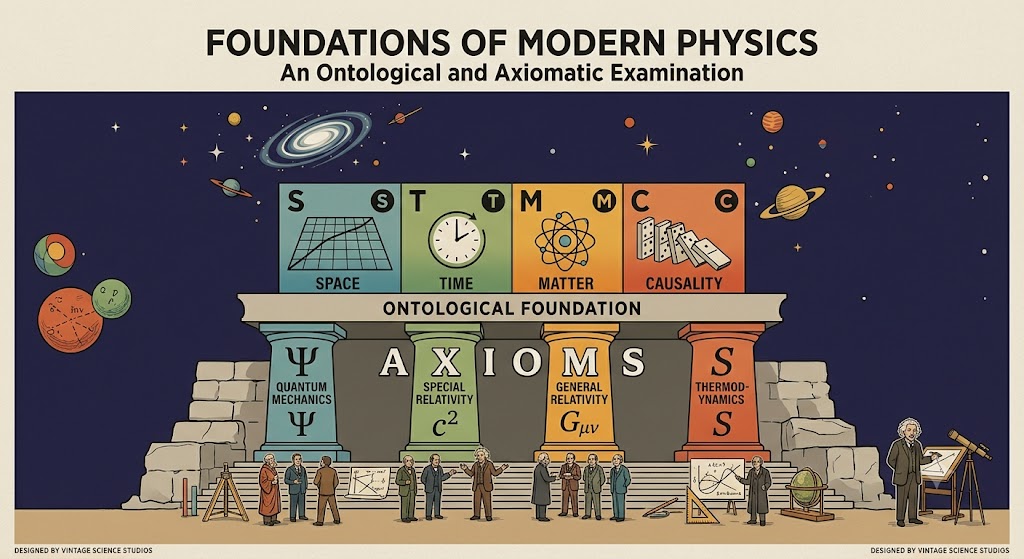
Part I: Axiomatic Foundations
Introduction: The Quiet Assumptions Behind Success
Modern physics is humanity’s most successful system of knowledge. It can calculate a satellite’s orbit to within centimeters, predict an electron’s magnetic moment correctly to more than ten significant figures, and reconstruct the universe as it was thirteen billion years ago from today’s cosmic microwave background radiation. This success has been repeated so consistently that we often forget to question its foundations.
This success rests on a set of principles: causality, locality, Lorentz invariance, symmetry and conservation laws, the action principle, the postulates of quantum mechanics, observer-independent reality and separability, the geometric structure of spacetime and the equivalence principle, the dimensionality of space, gauge symmetries, and the existence of change. The arrow of time and cosmological assumptions accompany them. These principles are tested in experiments, used in calculations, and assumed in theories. None explains itself.
What is an axiom?
An axiom is a proposition that is not proved within a system but is accepted so that the system can function. In mathematics, this is not troubling. Mathematics asks what can be derived from accepted axioms; it does not ask whether those axioms are “true.”
Physics is different. It claims to describe the real world. An axiom in physics is therefore more than an accepted starting point: it asserts that the world is this way. Physical axioms carry greater ontological weight than mathematical axioms.
A criterion: axioms and non-physical assumptions
This article draws the following distinction. A principle is an axiom if it is part of the laws of physics or their formulation. If it is a condition for doing science, it is a non-physical assumption. At least four assumptions of the latter kind underlie physics: the validity of classical logic (including non-contradiction and the excluded middle); induction (the unproven extension of observed regularities to unobserved places and times, as Hume noted); the intelligibility of nature; and the suitability of mathematical structures for describing the physical world. These cannot be tested from within physics and are not examined here. The sections below cover only principles of the first kind.
The experimental origins of axioms
The principles of physics are not arbitrary. Each has been distilled from a long record of observation and experiment. Causality is accepted because we observe the future depending on the past and have never observed the reverse. Lorentz invariance rests on the finding that light has the same measured speed in inertial frames (from Michelson–Morley onward). Experimental confirmation supports a principle, but does not say why it has this form or whether it is necessary.
The difference between “true” and “explained”
Experimental support for a proposition is not the same as an explanation of it. We know that energy is conserved. When we ask why, we reach Noether’s theorem: energy is conserved in systems whose action is invariant under time translations. Why are the laws of physics independent of the particular moment in time? At best, physics takes the symmetry as an input.
This article does not aim to criticize modern physics. It aims to show what kind of ground it stands on. Each principle is considered through an intuitive introduction, a technical definition, what it explains, and what it leaves unexplained. The conclusion is that modern physics rests on a tightly interwoven network of assumptions whose origins remain unexplained.
1. Causality
Intuitive introduction
First the ball is struck; then it moves. The alarm rings in the morning and we wake up, not the other way around. Everyday experience is built on cause-and-effect relations. Physics turns this intuition into a mathematical structure.
Technical definition
In physics, causality is the principle that an event can be affected only by events in its causal past and can affect only events in its causal future. In relativity, causal structure is defined by light cones: no influence can propagate faster than light. In quantum field theory, the corresponding condition is microcausality: observables at spacelike-separated points commute. This condition is closely connected to consistency in Lorentz-invariant local theories. In axiomatic quantum field theory frameworks such as the Wightman framework, it is imposed as a primitive axiom.
What does it explain?
Causality makes the initial-value problem well posed: the present state and the dynamical law determine a system’s evolution. In relativistic theories it makes cause-and-effect order observer-independent. In quantum field theory it ensures that measurements at spacelike separation do not influence one another.
Where is it used?
In Newtonian mechanics, force precedes motion. In general relativity, causal structure is part of spacetime geometry. In quantum field theory, microcausality is a basic condition of the theory. Maxwell’s equations describe fields propagating from their sources through retarded solutions. But the equations are time-symmetric and also admit advanced solutions. The retarded solution is selected by a boundary condition, not by the dynamical law. The Schrödinger equation is first order in time: the state at one moment determines both the future and the past. Reading evolution “from past to future” is a choice about which endpoint receives the boundary condition.
Experimental support
No violation of causality has been observed. The principle is supported across a wide range of fields, from particle physics to astrophysics.
Open question
Why is the universe causal? Physics takes causality as an input; it does not produce it as an output. If the direction of causality comes from boundary conditions rather than dynamical laws, causality and the arrow of time may not be separate mysteries (see “The Arrow of Time”). This is the first instance of a pattern that recurs throughout the article.
2. Locality
Intuitive introduction
When you switch on a lamp in your room, nothing changes on the Sun. Ripples from a stone thrown into water reach nearby points first and distant points later. Effects propagate through space.
Technical definition
Locality is the principle that interactions occur between neighboring points in space. The concept of a field gives this principle mathematical form: one particle affects another through the intervening field, rather than directly at a distance. The light cone marks the geometric boundary of this influence.
What does it explain?
Locality removes the problem of instantaneous action at a distance in Newtonian gravity. It also shapes quantum field theory: its Lagrangian is built from local operators.
Bell’s theorem
Quantum mechanics complicates locality. Bell’s theorem shows that the correlations of entangled systems cannot be explained by local hidden-variable theories. Violations of Bell inequalities have been confirmed repeatedly, from Aspect’s experiments through loophole-free tests. Information still cannot be transmitted faster than light (so signal locality is preserved), but the correlations cannot be explained by a classically local mechanism. The assumptions excluded by the theorem are discussed under “Observer-Independent Reality and Separability.”
Open question
Why does locality exist? Why does nature use a structure in which effects propagate, and why does the concept of a field work this way? Physics assumes locality but does not derive it.
3. Lorentz Invariance and the Constancy of the Speed of Light
Intuitive introduction
If you shine a light on a moving train, it travels at the same speed in every direction. An observer outside the train measures that same speed. A ball thrown on the train, by contrast, has the train’s speed added to its own from the outside observer’s perspective. Light does not follow that rule.
Technical definition
Lorentz invariance is the principle that the laws of physics take the same form in all inertial reference frames. Transformations between frames are described by Lorentz transformations, which leave the speed of light unchanged for all inertial observers. In local theories, this symmetry combines with translations and rotations to form the Poincaré group.
What does it explain?
- Maxwell’s equations are invariant under Lorentz transformations, not Galilean transformations. This incompatibility was the historical starting point of special relativity.
- It keeps causal order consistent. In Galilean physics, all observers agree on the time order of events. In special relativity, the order of two spacelike-separated events can vary between observers, while the order of timelike- or lightlike-separated events is the same for all inertial observers. Since cause-and-effect relations can be established only between timelike- or lightlike-separated events, causal order is preserved. If faster-than-light signals were possible, some observers would see the effect precede its cause.
- It explains time dilation and the relativistic corrections used by GPS. Without special- and general-relativistic corrections, GPS would accumulate position errors of kilometers per day.
Open question
Why does nature have Lorentz symmetry? The constancy of the speed of light is experimentally robust, but why the universe exhibits this symmetry group remains unexplained.
4. Symmetry
Intuitive introduction
A law that holds in a laboratory today will hold tomorrow and on Mars. Our ability to repeat experiments rests on this expectation.
Technical definition
A symmetry is invariance under a specified transformation. Continuous symmetries, such as translations and rotations, are defined by continuous parameters; discrete symmetries, such as parity and time reversal, are discrete transformations.
Noether’s theorem
Proved by Emmy Noether in 1918, the theorem says that every continuous global symmetry of a system’s action corresponds to a conserved quantity. Time-translation symmetry corresponds to conservation of energy; spatial-translation symmetry to conservation of momentum; and rotational symmetry to conservation of angular momentum.
What does it explain?
Symmetry turns conservation laws from arbitrary observations into consequences of symmetry. It constrains the form of theories by limiting the allowed interactions, and makes it possible to classify particles by group representations.
Open question
Why does nature have these symmetries? Noether’s theorem connects symmetry and conservation but does not explain the origin of symmetry. Nor does symmetry always hold. In general relativity, if there is no timelike Killing vector field—as in an expanding FRW universe—global energy conservation cannot be defined. Energy is conserved when spacetime has the relevant symmetry. The question is therefore not “Why is there time-translation symmetry?” but “Under what conditions, and why, are these symmetries exact or approximate?”
5. Conservation Laws
Intuitive introduction
Energy is neither created from nothing nor destroyed; it changes form. The total momentum of billiard balls is the same before and after a collision.
Technical definition
Conservation laws say that quantities such as energy, momentum, angular momentum, and electric charge remain constant over time in an isolated system. Through Noether’s theorem, these are consequences of symmetries. Conservation of electric charge corresponds to the U(1) gauge symmetry of the electromagnetic field.
What do they explain?
Conservation laws constrain dynamics by narrowing the states a system can evolve into before the equations are solved. They make it possible to calculate collisions and decays, and rule out forbidden processes such as charge appearing from nothing.
Open question
Why is a conserved quantity conserved? The question leads back to symmetry. Conservation laws are not the final link in the chain, but a link suspended in its middle.
6. The Action Principle
Intuitive introduction
You can calculate a ball’s trajectory by adding up the forces acting on it at every moment, or by selecting from all possible trajectories the one that makes a particular quantity stationary. Both descriptions yield the same result. The second is a common form of fundamental dynamics, from classical mechanics to field theory and general relativity.
Technical definition
A system’s dynamics are determined by the condition that a functional called the action is stationary. The Euler–Lagrange equations follow from this condition. In quantum theory, the corresponding path integral assigns each path an amplitude proportional to a phase determined by the action; the classical path dominates in the stationary-phase approximation. The Standard Model and general relativity are specified by particular actions.
What does it explain?
The action principle gathers the dynamics into a single scalar functional: the form of the laws is encoded in the form of the action. It makes Noether’s theorem possible, since the link between symmetry and conservation is established through the action. It also lets symmetries (Lorentz, gauge, and diffeomorphism invariance) and consistency conditions such as renormalizability constrain the choice of action.
What does it leave unexplained?
It is unclear why dynamics should follow from an extremum principle. The principle also has limits: systems without a local Lagrangian or systems that lose energy (such as frictional systems) do not fit the standard form directly, although they can be rewritten using additional structures. The path integral offers an intuition, but it is itself a postulate.
Open question
Why does nature follow a path that makes the action stationary? Why does the action have this form? Physics takes it as an input.
7. The Postulates of Quantum Mechanics
Quantum mechanics has unmatched experimental accuracy, yet it is silent about why its postulates take their present form. Each postulate is considered below in the same way.
Hilbert space and linearity
Intuitive: Possible states live in a space where they can be added and scaled.
Technical: Every quantum system is associated with a complex Hilbert space. Linear combinations of states are also valid states.
What does it explain? It makes superposition possible and explains interference.
What does it leave unexplained? Why nature uses a complex, linear vector space. Real and quaternionic formulations can also be defined mathematically. Linearity has been tested with great precision, and nonlinear corrections are tightly constrained, but why linearity holds exactly is unknown. Reconstruction programs (Hardy, Masanes–Müller, and others) derive the quantum formalism from information-theoretic axioms, but those axioms are themselves accepted assumptions.
The state vector
Intuitive: A single object carrying information about a system’s measurable quantities.
Technical: A pure state is represented by a ray in Hilbert space (an equivalence class of vectors for which overall phase and normalization are irrelevant). Mixed states require a density matrix.
What does it explain? It provides one comprehensive description in place of separate classical variables such as position and velocity.
What does it leave unexplained? Whether the state vector represents something real or only our knowledge of the system—its ontological status—remains controversial.
Operators
Intuitive: Every measurable quantity corresponds to a mathematical object.
Technical: Observable quantities are associated with Hermitian operators. Their eigenvalues are possible measurement outcomes. Measurement involves projection onto eigenspaces.
What does it explain? It shows how measurement outcomes can be discrete.
What does it leave unexplained? Real-valued outcomes require Hermitian operators, but why observables are represented by operators, and which operators are physical, remain part of the assumed structure.
The Born rule
Intuitive: The probability of an outcome is determined by the square of its amplitude.
Technical: The probability of an outcome is the squared absolute value of the amplitude between the relevant states.
What does it explain? It connects the quantum formalism to experimental statistics.
What does it leave unexplained? There is no generally accepted derivation of why probabilities are given by the square of the amplitude, though partial results exist. Gleason’s theorem shows that in Hilbert spaces of dimension at least three, additivity conditions on probability assignments to orthogonal projectors entail the Born form. The derivations proposed by Deutsch–Wallace and Zurek rely on decision-theoretic and symmetry assumptions that remain controversial.
Unitary evolution
Intuitive: An unmeasured system changes deterministically and reversibly.
Technical: The state evolves according to the Schrödinger equation and unitary operators. This guarantees conservation of total probability.
What does it explain? It provides a consistent, predictable time evolution.
What does it leave unexplained? Why evolution is unitary, and how unitary evolution relates to measurement. Wigner’s theorem says symmetries are represented by unitary or anti-unitary transformations, but that representation structure is assumed.
Measurement
Intuitive: Something indefinite when unobserved takes a definite value when measured.
Technical: In the standard formulation, measurement is postulated to reduce the state to an eigenstate of the measured operator.
What does it explain? It connects the formalism to experimental observations.
What does it leave unexplained? The measurement problem remains unresolved. Interpretations diverge here: Everett’s interpretation has no collapse, Bohmian mechanics includes additional variables, and GRW-type theories treat collapse as a dynamical process. No experiment has yet determined which, if any, is correct.
Spin
Intuitive: Particles have intrinsic angular momentum, though it is not like classical rotation.
Technical: Spin is intrinsic angular momentum independent of spatial motion. In non-relativistic quantum mechanics, it is classified by irreducible representations of the rotation group’s covering group, SU(2). In relativistic theory, it corresponds to representations of the Poincaré group: SU(2) labels massive particles, while helicity labels massless particles.
What does it explain? Together with the Pauli exclusion principle, spin explains atomic shells, the periodic table, magnetic moments, and fine structure. The spin-statistics theorem derives in relativistic quantum field theory that integer-spin particles obey Bose statistics and half-integer-spin particles obey Fermi statistics.
What does it leave unexplained? Spin is not derived from relativity. Pauli formulated it in a non-relativistic framework. The Dirac equation naturally includes spin one-half and gives the electron a gyromagnetic ratio near two, but this is not an independent argument requiring spin to exist. What remains open is why these particular spin values (zero, one-half, one, and so on) occur and why this is the particle content of nature.
Indistinguishability
Intuitive: Two electrons cannot be distinguished from one another. No measurement can detect that they have been exchanged.
Technical: Observables for identical particles must remain unchanged under exchange.
What does it explain? The Pauli exclusion principle explains the stability of atoms, the structure of chemical bonds, and the rigidity of matter.
What does it leave unexplained? In three or more spatial dimensions, the topology of configuration space permits only symmetric (bosonic) and antisymmetric (fermionic) wave functions (Leinaas–Myrheim). The connection between spin and statistics is derived by the spin-statistics theorem in relativistic quantum field theory. Anyons are also possible in two spatial dimensions. The open question is therefore not why there are only two classes, but why indistinguishability is a fundamental feature of nature and why space has three dimensions (see “Spatial Dimensionality”).
8. Observer-Independent Reality and Separability
Intuitive introduction
The Moon is still there when you are not looking at it. Everyday physics quietly assumes that a system’s properties are definite even before measurement, and that two objects in different places can be described independently.
Technical definition
There are two distinct assumptions. The first is realism (counterfactual definiteness): measurable quantities have definite values even when they are not measured. The second is separability: the state of a composite system made of spatially separated parts is determined by the states of those parts and their interactions. The whole carries no additional information independent of its parts.
Bell’s theorem shows that locality, realism, and measurement independence (the assumption that measurement settings can be chosen independently of hidden variables) are jointly incompatible with quantum predictions. Experiments have confirmed those predictions. At least one of the three assumptions must therefore be abandoned. Which one depends on the interpretation: Bohmian mechanics abandons locality, the Everett interpretation abandons the assumption of a single outcome in measurement, and superdeterministic proposals abandon measurement independence. In entangled states, the composite system’s state cannot be determined from the states of its parts; separability therefore does not generally hold in quantum theory.
What do these assumptions explain?
They make the concept of physical state and the comparison of theory with experiment possible. They also let us analyze composite systems by dividing them into parts, a method used throughout much of physics.
What do they leave unexplained?
Quantum theory does not specify separately which assumption fails under which conditions. Nor does it draw a clear boundary: why macroscopic objects behave approximately realistically and separably enters the domain of the measurement problem and decoherence, and is not fully resolved.
Open question
Is physical reality independent of the observer, or do states have only a relational or information-theoretic meaning? Is the universe made of its parts, or does the whole come first? The answers directly shape our ontology.
9. Spacetime
Intuitive introduction
Space is not a passive stage on which objects sit. Since Einstein, we have known that spacetime is a dynamic entity that interacts with mass and energy and can curve.
Technical definition
In general relativity, spacetime is a smooth four-dimensional manifold. The metric tensor determines distances and time intervals. Einstein’s field equations connect geometry to the distribution of mass-energy. Two structural assumptions are implicit here: spacetime is a continuous manifold, and the metric is sufficiently smooth (differentiable).
What does it explain?
General relativity describes gravity geometrically. Newton’s law is recovered in the weak-field, low-velocity limit. The theory explains phenomena such as Mercury’s perihelion precession, the bending of light, gravitational waves, and black holes. It also provides the basis for cosmological models of an expanding universe.
What does it leave unexplained?
The assumptions of continuity and smoothness have not been experimentally tested down to the Planck scale. Singularity theorems show where general relativity reaches the limits of these assumptions. Discrete or fuzzy models of spacetime have been proposed, but none has been experimentally confirmed.
Open question
Why does spacetime exist, and why is it a continuous manifold? More sharply, is spacetime fundamental or an arrangement emerging from a more basic structure? Many approaches to quantum gravity (loop quantum gravity, causal set theory, and the holographic principle) address this question, but there is no definite answer that can be tested experimentally.
10. The Equivalence Principle
Intuitive introduction
When an elevator is in free fall, objects inside become weightless and behave alike. Whatever their mass or composition, all bodies fall with the same acceleration in a vacuum.
Technical definition
The principle has several levels. The weak equivalence principle states that inertial mass and gravitational mass are identical, so free fall is independent of an object’s composition (Galileo). The Einstein equivalence principle states that, in a sufficiently small region, all physics in a freely falling frame is as it is in special relativity. The strong equivalence principle extends the same claim to gravitational energy.
From Eötvös’s experiments to the MICROSCOPE satellite, tests have confirmed the weak equivalence principle to a relative precision of about one part in 1015.
What does it explain?
The principle is the experimental basis for a geometric description of gravity: since all bodies follow the same path, that path can be treated as a property of spacetime rather than of the body. It made the construction of general relativity possible and explains the universality that distinguishes gravity from other forces.
What does it leave unexplained?
It does not explain why the two masses are identical. In Newtonian physics, this is a coincidence because the concepts are defined independently. General relativity makes their identity an input to the theory but does not explain it. Other forces have no equivalent universality: charged bodies in the same electric field can have different accelerations. How the principle should be expressed at the quantum level also remains open.
Open question
Why is gravity universal? Does the equivalence principle follow from the claim that spacetime is a dynamic geometry, or does it require that claim? It is not known whether a theory of quantum gravity can derive this principle.
11. Spatial Dimensionality
Intuitive introduction
We describe the world using three spatial directions and one time direction. Most theories take this number as an input rather than explaining it.
Technical definition
The observed universe is modeled as a manifold with one time dimension and three spatial dimensions. Dimensionality determines many outcomes: Gauss’s law and inverse-square force laws, the behavior of wave equations, and the stability of bound states.
What does it explain?
Ehrenfest’s argument shows that stable orbits under inverse-square-like forces, and stable atoms at the quantum level, are not possible with more than three spatial dimensions. A single time dimension is also needed for well-posed hyperbolic equations: more than one time dimension spoils the initial-value problem. Thus three space dimensions and one time dimension are connected to the existence of complex, stable structures, but this is an argument from suitability, not a derivation.
What does it leave unexplained?
Why the number of dimensions is what it is. Some theories (string theory and Kaluza–Klein approaches) predict extra dimensions and explain their absence from observation through compactification. None has determined the number with experimentally testable precision.
Open question
Is dimensionality a law of nature, an initial condition, or a result emerging from a more fundamental structure?
12. Gauge Symmetries
Intuitive introduction
The Standard Model’s three forces (electromagnetic, weak, and strong) share a remarkably similar mathematical framework.
Technical definition
Gauge symmetry is the principle that a field theory remains invariant under a local transformation applied independently at every point in space. To preserve local symmetry, the theory must contain a gauge field (the photon, W and Z bosons, and gluons). The Standard Model is built from the product of three symmetry groups corresponding to the three forces: the three-dimensional special unitary group for the strong interaction, the two-dimensional special unitary group for the weak interaction, and the one-dimensional unitary group for electromagnetism.
What does it explain?
The gauge principle determines the form of interactions through symmetry: gauge fields and couplings follow from it. It describes electroweak unification and mass generation through the Higgs mechanism in a consistent framework. It produces renormalizable predictions that agree with experiments to high precision.
Open question
Why exactly these groups? Physics does not explain why nature realizes this structure rather than another combination. Grand unified theories (GUTs) try to explain these groups as the result of a larger group breaking, but then the origin of that larger group must be explained.
13. The Existence of Change (Dynamism)
Intuitive introduction
The universe is not static: objects move, systems evolve, and states follow one another. Physics takes the existence of change, and the fact that laws govern it, as a starting point. A universe in which nothing changed would also be logically consistent.
Technical definition
Most physical theories assume that a system’s state changes with respect to an evolution parameter (time), and that this change is determined by a law (an equation of motion). In this framework, motion is not a separate principle but a consequence of assuming space, time, and dynamics. Dynamism has two components: the existence of change and the regularity of that change.
What does it explain?
Dynamism makes prediction possible: a state at one moment can be used to calculate a state at another. It also makes it possible to define all kinematic and dynamical concepts, such as motion, energy, and acceleration.
What does it leave unexplained?
Whether change is fundamental or derived. This is not an empty philosophical question; it takes a concrete form in quantum cosmology. Applying the Hamiltonian constraint to a closed universe in the Wheeler–DeWitt equation yields an equation with no time parameter: the universe’s total Hamiltonian annihilates its state. This is called the “problem of time.” One approach (relational time of the Page–Wootters type) defines change as a correlation between two subsystems of the universe: even without a universal time, one part appears to evolve relative to another. Other approaches do not derive time or choose an internal variable. These do not yet offer a complete solution, and how time should be defined remains debated.
Open question
Why is there a universe with regular change instead of one in which nothing changes? Is change fundamental, or relational and derived? This question can be read as the counterpart of the question of persistence in Part II: persistence is something we can ask about within a changing world.
14. The Arrow of Time
Intuitive introduction
An egg falls and breaks; a broken egg does not spontaneously reassemble. Time seems to flow in one direction, from order toward disorder.
The second law
The second law says that the entropy of an isolated system does not decrease over time; statistically, the probability of a decrease is negligibly small. In statistical mechanics this follows from the overwhelming number of microstates corresponding to macroscopically “disordered” states. The second law is therefore not an independent axiom, but a statistical result derived from microscopic dynamics and an initial condition. The efficiency limits of heat engines and the direction of processes follow from it.
What is axiomatic: the direction
Almost all microscopic laws are time-symmetric. Given a macrostate, entropy is therefore statistically expected to increase toward the past as well as toward the future. The additional assumption that rules out an increase toward the past is that the universe began in a very low-entropy state (the Past Hypothesis, associated with Albert; Penrose’s Weyl curvature hypothesis is a cosmological version). This hypothesis does not follow from dynamical laws; it is added separately. Without it, a problem arises: if we reason only from “typical” states, our memories and records of the past would also be unreliable (the Boltzmann brain problem). The arrow is an input required for scientific inference itself.
The distinction between laws and initial conditions
This section also reveals another implicit assumption in physics: the world is described by time-symmetric laws and a separate initial condition. Which information counts as a “law” and which as a “condition” depends on the form of the theory. A theory that made the initial condition part of its law could place the arrow of time in the law itself.
Forms of the arrow of time
The arrow of time appears in several forms: the thermodynamic arrow (increasing entropy), the causal arrow (the selection of retarded solutions), the cosmological arrow (the expansion of the universe), the quantum arrow (state reduction in measurement), and the psychological arrow (memory and records). Whether they have a common origin is unknown. The thermodynamic and causal arrows may be connected because both depend on a low-entropy beginning. The relation between the cosmological and thermodynamic arrows is unclear: expansion alone does not explain increasing entropy; a low-entropy beginning is still needed. The quantum arrow depends on interpretation and is disputed. The psychological arrow is probably a consequence of the thermodynamic one.
Open question
Why does the arrow of time exist? At the axiomatic level, what remains unexplained is not the second law but the low-entropy initial condition. We do not know why the universe began in such a state, or whether the different arrows of time share a single source.
15. Cosmological Assumptions and Open Observational Components
The items in this section are not all of the same kind. The cosmological principle and the stability of constants are assumptions. Dark matter and dark energy are observational components interpreted through current theories. Fine-tuning is not an axiom, but a demand for explanation. These distinctions are kept in view.
The cosmological principle
This is the assumption that the universe is homogeneous and isotropic on large scales. What does it explain? It makes it possible to apply FRW models and Einstein’s equations to cosmology. Open question: Observations support it on large scales, but why the universe is this way remains unexplained.
The stability of constants
It is assumed that fundamental constants (such as the fine-structure constant) do not vary over time or space. This is tested experimentally: atomic clocks, the natural Oklo reactor, and quasar spectra set upper bounds, and no variation has been consistently confirmed. Why the constants have these values and why they do not change remain unknown.
Dark matter
Galaxy rotation curves, gravitational lensing, and cosmic microwave background data point to much more gravitational influence than visible matter can provide. This effect is attributed to a component (dark matter) that has not yet been directly detected. Modifying the laws of gravity has also been proposed, but such approaches have difficulty explaining all the observations.
Dark energy
Within general relativity and a homogeneous-isotropic (FRW) model, the accelerated expansion of the universe points to a component with negative pressure (in its simplest form, the cosmological constant). Alternatives, including modified gravity and backreaction from inhomogeneities, are being tested. The physical origin of this component is unknown.
Fine-tuning
The claim that fundamental constants lie in narrow ranges that permit stars, atoms, and life is disputed. How narrow those ranges are, which parameters can be varied independently, and what probability measure should be used are all debated.
16. Open Problems in Physics
The preceding sections examined principles one by one. This section lists problems that arise where those principles operate together.
The measurement problem. The relationship between unitary evolution and reduction during measurement receives different answers in different interpretations, and experiments have not distinguished between them.
The black hole information paradox. The tension between quantum-mechanical unitarity and calculations of Hawking radiation remains. Partial proposals (including holographic approaches and island formulas) exist, but there is no complete solution.
Quantum gravity. There is no experimentally tested theory that unifies general relativity and quantum mechanics.
The cosmological constant problem. Contributions to vacuum energy density in quantum field theory depend on the ultraviolet cutoff. If the cutoff is set at the Planck scale, the estimate exceeds the observed dark-energy density by roughly 120 orders of magnitude. This is not a precise prediction of the theory, but a naive estimate based on a scale. The discrepancy becomes smaller with lower cutoffs but remains very large. The underlying problem is why the different contributions and the bare cosmological constant cancel one another so precisely.
The hierarchy problem. The Higgs mass is sensitive to high-energy scales through quantum corrections. The naturalness criterion does not explain why the electroweak scale is so small compared with the Planck scale.
Some of these problems (measurement, quantum gravity, and the information paradox) arise where principles discussed above come into tension with one another. Others (the cosmological constant and hierarchy problems) concern parameter values the principles do not explain. At this stage, the claim that they share a common origin is a possibility to be tested, not an assertion.
Conclusion
Modern physics faces an additional question not because it has failed, but because it has succeeded. Nearly all of the principles it uses are supported by experiment, yet why they exist, why they take these forms, and why they work together remains unexplained. This is an explanatory gap more than an experimental crisis. Physics may ask not only how nature behaves, but why that behavior follows these principles.
Part II: From Axiomatic Foundations to Ontology
Introduction: More Explanation with Fewer Assumptions
Scientific progress has often come not from adding new laws but from finding the common origins of existing ones. Newton derived Kepler’s empirical laws of planetary motion from the law of gravitation, unifying terrestrial and celestial mechanics under one law. General relativity replaced Newtonian gravity, recast gravity as the geometry of spacetime, and recovered Newton’s laws as a low-velocity, weak-field limit. It also explained deviations Newtonian theory could not, such as Mercury’s perihelion precession. Everyday experiences of heat were connected to atomic motion through statistical mechanics. Maxwell unified electricity and magnetism in a single field, and electroweak theory brought electromagnetism and the weak force together as different aspects of a gauge structure.
Each unification follows a similar pattern: phenomena that seem independent turn out to be different expressions of a deeper structure. The same question can be asked of physics’ own principles: are causality, locality, Lorentz invariance, symmetry, conservation, the action principle, and the quantum postulates truly independent, or are they different faces of a common origin?
1. What Should a Good Fundamental Theory Be Like?
This section is methodological. It sets out the criteria to be used. A fundamental theory should:
- Use as few primitive concepts as possible. Every new primitive concept adds explanatory burden.
- Reproduce experimental physics. A theory that contradicts observations is unacceptable, however elegant it may be.
- Show why structures such as Hilbert space and the Lorentz group arise, rather than merely assuming them.
- Add no new free parameters. Every free parameter raises an unexplained “why this value?” question.
- Turn at least some of the principles in Part I from independent assumptions into consequences.
- Be falsifiable. Otherwise, it cannot go beyond metaphysical speculation.
2. What Is Ontology?
In physics, ontology asks what really exists. The difference between a theory’s mathematical formalism and what it describes is an ontological choice.
The history of physics has offered different answers. In classical physics, the ontology is particles: pointlike objects with position and mass that exert forces on one another. In field theory, ontology shifts to fields: structures spread through space, with a value at every point. With quantum information theory, some physicists argue that information is fundamental (as in Wheeler’s “it from bit”). General relativity places ontology in geometry: gravity is not a force but the curvature of spacetime. Some approaches to quantum gravity propose that none of these is fundamental and that each emerges from a deeper structure. As discussed above under observer-independent reality and the existence of change, whether reality is observer-independent and whether change is fundamental are also part of this choice.
3. What Is the Least We Can Assume?
What remains if we remove everything from the universe, one thing at a time? Remove particles and fields remain. If we remove space, can relations remain? If we remove time, can an ordering principle remain? Can we conceive of a structure without a conserved quantity if we remove energy? If we remove mathematics, is anything left beyond logical consistency?
This thought experiment suggests a working proposal: perhaps what is fundamental is not an object but a relational structure. This is a starting choice, not a conclusion. The question of what the relata—the things related—are remains open.
4. Why Causality?
If a relational structure is fundamental, what kind of relation is it? Correlation has no direction: it says “A and B are observed together” without saying which determines the other. The concept of information already presupposes a structure that carries it. A causal relation has direction and ordering.
This choice is not a derivation but a preference, justified as follows: a causal relation is the least-assumptive kind of relation that carries direction and order. The same objection applies here: both the relata and direction are assumptions. That assumption is not concealed. Causal structure is taken as an input and constrained by consistency conditions. Explaining causality itself may lie outside the scope of this framework.
5. Why Is Consistency Necessary?
If the fundamental structure is a network of causal relations, the question arises of how the network can continue. Not every set of relations can remain internally consistent.
Three concepts are introduced here. They are not yet formally defined objects, but names for the conditions being sought. Causal consistency means that a relational structure does not contradict its own causal links. Non-divergence means that the quantities defining the structure do not grow without bound. Closure means that the structure’s existence can be expressed through its own relations without appealing to an external regress. The first task is to give each concept a mathematical counterpart. If that cannot be done, the proposal should be considered unsuccessful.
6. Persistence
The question here is why some existing structures persist. Why is the universe not chaotic, with everything dissolving at every moment, but instead filled with the billions-of-years stability of atoms, stars, and galaxies? “Why is there something rather than nothing?” is outside the scope of this article. The narrower question is asked under the assumption that change exists: persistence is the preservation of some structures in a changing world.
The proposal is a working hypothesis, not an answer: persistence may be a property of structures that satisfy consistency conditions. The hypothesis avoids tautology only if consistency is defined by a criterion independent of persistence. Otherwise, “persistent structures are structures that can persist” says nothing more. No claim about persistence is made until a criterion of consistency is defined. The words “elimination” and “dissolution” are used metaphorically, not to describe a temporal process. No temporal selection mechanism is assumed, since time itself is among the concepts the article aims to explain.
7. Conclusion
Part I ended with the question: why do the laws of physics exist? This article does not answer it. It points to a possible direction for seeking an answer: take a causal relational structure as fundamental and connect persistence to conditions of consistency.
This direction has value only if consistency, non-divergence, and closure can be defined formally and if that definition recovers known physics. If they cannot be defined, the proposal should be considered unsuccessful. For now, what we have is not an answer to these questions but their form: physics’ principles are supported by experiment but not explained, and whether they can be explained is an open question that can be asked plainly and honestly.